Making monolithic integrated systems with GaN
– HW Choi, WY Fu, KH Li and YF Cheung

Compound Semiconductor, vol. 24, 2, pp. 54-57 (2018)
GaN produces great LEDs, lasers and transistors. Just imagine the possibilities when two or more of these classes of devices are united on the same chip.
Read at Compound Semiconductor
InGaN RGB Light-Emitting Diodes With Monolithically Integrated Photodetectors for Stabilizing Color Chromaticity
– KH Li, YF Cheung, W Jin, WY Fu, ATL Lee, SC Tan, SY Hui, and HW Choi
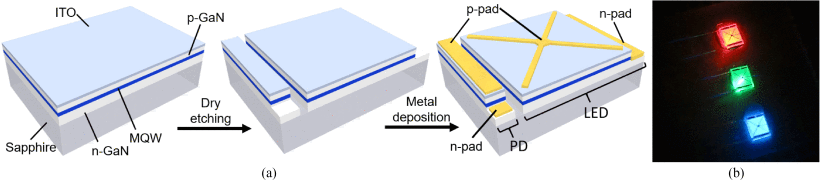
IEEE Transactions on Industrial Electronics, vol. 67, 6, pp. 5154-5160 (2020)
In this paper, a solution toward realizing color chromaticity stabilized InGaN red, green, and blue (RGB) light-emitting diode (LED) is proposed and demonstrated. The InGaN/GaN multiple quantum wells (play a key role in light emission from the LEDs and photodetection from the photodetectors (PDs). The spectral overlaps between the emission and absorption spectra are measured and the photocurrents of the PDs exhibit linear behavior with increasing LED driving currents. The solution involves the use of RGB chips with monolithically integrated PDs that detect the levels of light output from an individual chip in real time, whose photocurrent signals are fed to LED driver circuits that make use of the signal to provide a driving current that stabilizes the light output. Adoption of this feedback strategy results in CIE coordinates drifts of Δ(0.003, 0.005) over the 400 h duration of testing, proving to be an effective way of stabilizing color chromaticity from RGB LEDs.
Intensity-Stabilized LEDs With Monolithically Integrated Photodetectors
– KH Li, H Lu, WY Fu, YF Cheung, and HW Choi
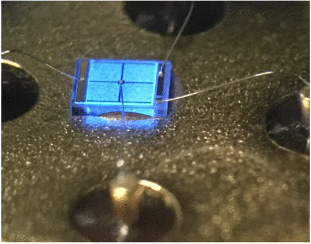
IEEE Transactions on Industrial Electronics, vol. 66, 9, pp. 7426-7432 (2019)
To overcome light output degradations and fluctuations of intensities from light-emitting diodes (LEDs) over time, the monolithic integration of InGaN LEDs and photodetectors (PDs) is demonstrated in this paper. The InGaN/GaN multiquantum wells (MQWs) play the role of light emission and detection from the LED and PD, respectively. Despite the larger bandgap energies of the InGaN layers, the MQWs absorb light emitted by the LED due to the band tail effect, extending the absorption range up to 460 nm, which correspond to the peak wavelength of emission. The tiny-sized PD detects light from the adjacent LED coupled through the sapphire substrate to generate a photocurrent that is proportional to its light output, but remains unresponsive to ambient lighting. Apart from real-time light output monitoring, the photocurrent can be used as a feedback signal for regulation of light output. A microcontroller-based feedback circuit has been implemented to drive the LED and the photocurrent level is maintained to a preset value by adjustment of the driving current. Using this scheme, light output from the LED is stabilized to within ~0.2% over 1-h periods.
Monolithically integrated InGaN/GaN light-emitting diodes, photodetectors, and waveguides on Si substrate
– KH Li, WY Fu, YF Cheung, KKY Wong, Y Wang, KM Lau, and HW Choi
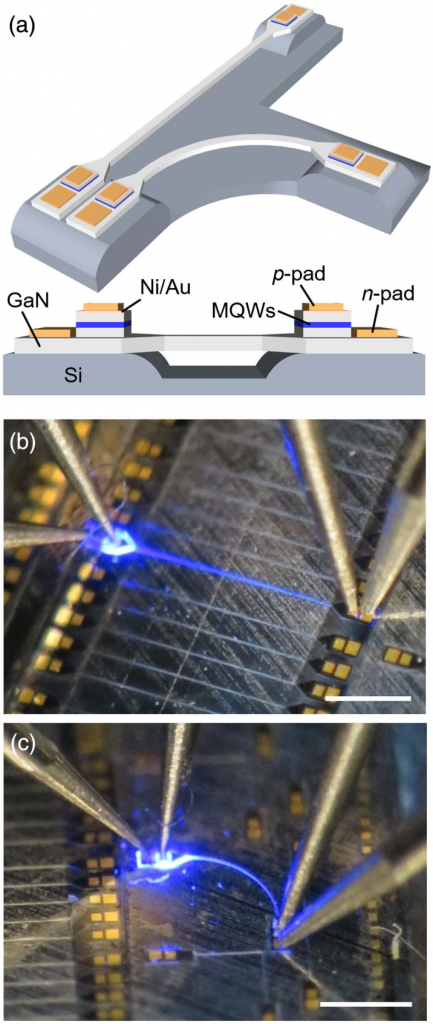
Optica, vol. 5, 5, pp. 564-569 (2018)
The characteristics of monolithically integrated light-emitting diodes (LEDs), photodetectors (PDs), and waveguides on a GaN-on-Si wafer are investigated. The InGaN/GaN multi-quantum wells, which are responsible for blue light emission in LEDs, are also used for photodetection in PDs. Despite the Stokes shift, a spectral overlap of ∼25 nm between the emission and absorption spectra provides the PDs with sufficient photosensitivity to signals from the emitter while remaining insensitive to ambient lighting. Optical interconnects in the form of linear or bent suspended waveguides bridging the LEDs and PDs are formed by selective detachment of etched GaN mesas from the Si substrate. Additionally, the PDs can be detached from the substrate and remounted on an elevated platform, owing to the flexibility of the thin-film waveguide. The 150 μm×150 μm LEDs and PDs exhibit rapid response on nanosecond time scales, which is attributed to fast radiative recombinations as well as minimized resistive-capacitive (RC) delays, enabling transmission of pseudorandom binary sequence (PRBS) data signals at rates of 250 Mb/s with an opening in the eye diagram. Together with multichannel transmission free of crosstalk, the ability of the planar and three-dimensional monolithic photonic systems to handle visible-light communication (VLC) applications is demonstrated.
Monolithic Integration of GaN-on-Sapphire Light-Emitting Diodes, Photodetectors, and Waveguides
– KH Li, YF Cheung, WY Fu, KK Wong, and HW Choihoi
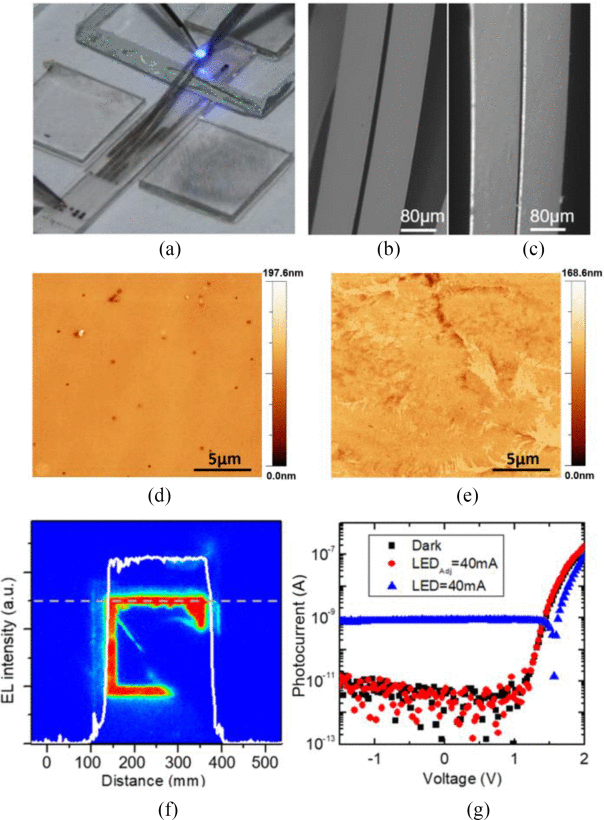
IEEE Journal of Selected Topics in Quantum Electronics, vol. 24, 6, pp. 1-6 (2018)
We demonstrate the monolithic integration of light-emitting diodes (LEDs), photodetectors (PDs), and waveguides on a GaN-on-sapphire wafer. The InGaN/GaN multi-quantum wells (MQWs) play a key role in light emission from the LED and photodetection from the PD. Despite large Stokes shift between absorption and emission energies in the InGaN layer, the MQWs are capable of absorbing light emitted by the LED due to the band tail effect, extending the absorption range up to 460 nm. The existence of optical crosstalk is mainly due to optical channeling in the transparent sapphire substrate beneath the LED, but can be eliminated by the detachment of the LED and waveguide via selective-area laser lift-off process. With the bendable waveguides and remounting of the LED onto an elevated platform, the feasibility of routing optical signal between two different planes is demonstrated. Apart from crosstalk-free performance, the three-dimensional system exhibits more than five times higher photocurrent than the planar system, attributed to spectral blue-shift of the LED and enhanced optical confinement in suspended waveguide. The LEDs and PDs also exhibit rapid response on the nanosecond time-scale, enabling transmission of data signals at rates of 250 Mb/s with an opening in the eye diagram.